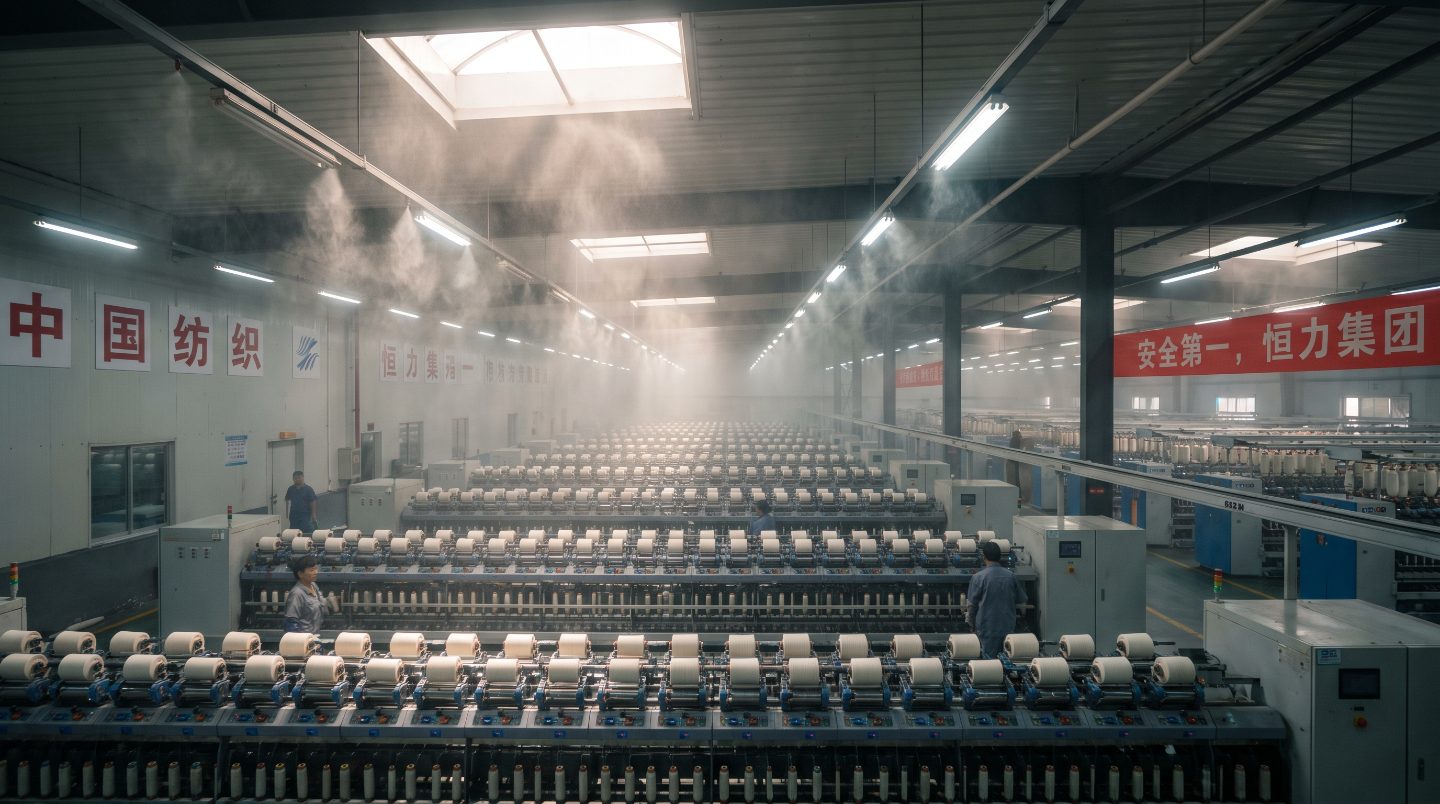
Application of Dehexin High-Pressure Misting Humidifiers in Textile Mills: Solving Production Pain Points and Boosting Quality and Efficiency
Hebei Shandao Environmental Technology Co., Ltd.’s high-pressure micro-mist humidifiers—featuring precise humidity control, exceptional dust and static electricity elimination, and intelligent operation—perfectly meet the rigorous requirements for localized environmental improvement in textile workshops. As industrial humidification technology continues to evolve, Dehexin’s high-pressure micro-mist systems are poised to play an increasingly vital role in driving the high-quality development of the textile industry.
In the modern textile industry, controlling temperature and humidity within the workshop is critical to product quality and production efficiency. Textile fibers are highly sensitive to humidity fluctuations; when the workshop air becomes too dry, a host of production issues can arise. Thanks to their high efficiency, uniformity, and energy-saving capabilities, high-pressure micro-mist humidifiers have become standard equipment for textile enterprises seeking to improve localized environments while cutting costs and boosting efficiency.
I. Pain Points and Hazards of Dry Textile Workshop Environments Textile processes—such as two-for-one twisting, spinning, and weaving—demand strict humidity control. Low humidity levels in the workshop lead to three major issues: · Static electricity buildup and soaring yarn breakage rates: Dry environments increase surface friction on yarns, easily generating static electricity. Static causes fibers to repel or attract one another, leading to yarn fuzzing and brittle breakage; it also triggers the "fly" phenomenon (airborne fiber waste), causing equipment entanglement and downtime, which severely disrupts production continuity. · Airborne dust and equipment wear: In low-humidity environments, short fibers and dust easily become suspended in the air. Once these particles settle on precision machinery, they accelerate component wear, shorten equipment lifespan, and drive up maintenance costs. · Compromised product quality and employee health: Insufficient humidity reduces yarn strength and results in rough, uneven fabric surfaces, leading to higher defect rates. Furthermore, high concentrations of dust and airborne fibers pose potential respiratory risks to frontline workers and diminish the comfort and safety of the working environment.
II. Working Principle and Key Advantages of High-Pressure Micro-Mist Humidification Systems High-pressure micro-mist humidifiers offer outstanding technical advantages tailored to the large-scale, high-ceiling environments typical of textile mills. The system operates by using a high-pressure plunger pump to pressurize purified water to 50–70 kg/cm², delivering it through high-pressure piping to precision atomizing nozzles. At the nozzle, the water is instantly converted into an ultra-fine mist with droplet diameters of just 5–10 microns. These tiny mist droplets rapidly absorb heat from the air and evaporate, uniformly raising the relative humidity throughout the workshop without wetting the equipment or dampening the yarn. Key advantages include: · Uniform, wide-area coverage: Through scientific piping layout and precise nozzle calculations, the water mist covers every corner of the workshop without dead zones, quickly and accurately regulating humidity to the ideal range required for the process (e.g., 60% ± 5% RH). · Intelligent humidity control and energy efficiency: Modern high-pressure micro-mist systems feature intelligent microcomputer controls that monitor real-time changes in workshop temperature and humidity, automatically adjusting equipment operation. Compared to traditional humidification methods, energy consumption is significantly lower. The systems also include multiple safety features—such as automatic power-off upon water shortage and automatic pressure relief—enabling efficient, unattended management. · Dual benefits of dust suppression and static elimination: As the ultra-fine mist floats in the air, it effectively captures suspended dust particles, causing them to settle. Simultaneously, it increases air conductivity to completely eliminate static electricity hazards, providing dual protection for textile production.
III. Practical Application Results and Value Realization In the textile industry, high-pressure micro-mist humidification systems have delivered tangible economic benefits to enterprises. Taking a large-diameter circular knitting workshop at a major textile factory as an example: following the deployment of the high-pressure micro-mist solution, static electricity issues were fundamentally resolved. Incidents of fiber entanglement and dust adhesion were drastically reduced, resulting in smoother, cleaner fabric surfaces and a significant increase in product pass rates. Furthermore, the stable humidity environment led to a marked reduction in yarn breakage and a substantial increase in equipment uptime, driving a dramatic boost in production efficiency. In the long run, the system not only increased production capacity and yield but also reduced equipment wear caused by static electricity and dust, lowered maintenance costs, and truly achieved the comprehensive goals of improved quality, increased output, and higher revenue.
IV. Conclusion For textile enterprises, selecting the right humidification equipment is not merely a necessary step to improve the production environment; it is a crucial element in enhancing core competitiveness. With their precise humidity control, exceptional dust and static electricity removal capabilities, and intelligent operating modes, high-pressure micro-mist humidifiers perfectly meet the rigorous requirements for localized environmental improvement in textile workshops. As industrial humidification technology continues to evolve, high-pressure micro-mist systems are poised to play an increasingly vital role in driving the high-quality development of the textile industry.
Need help applying this to your project? Talk to our engineering team.