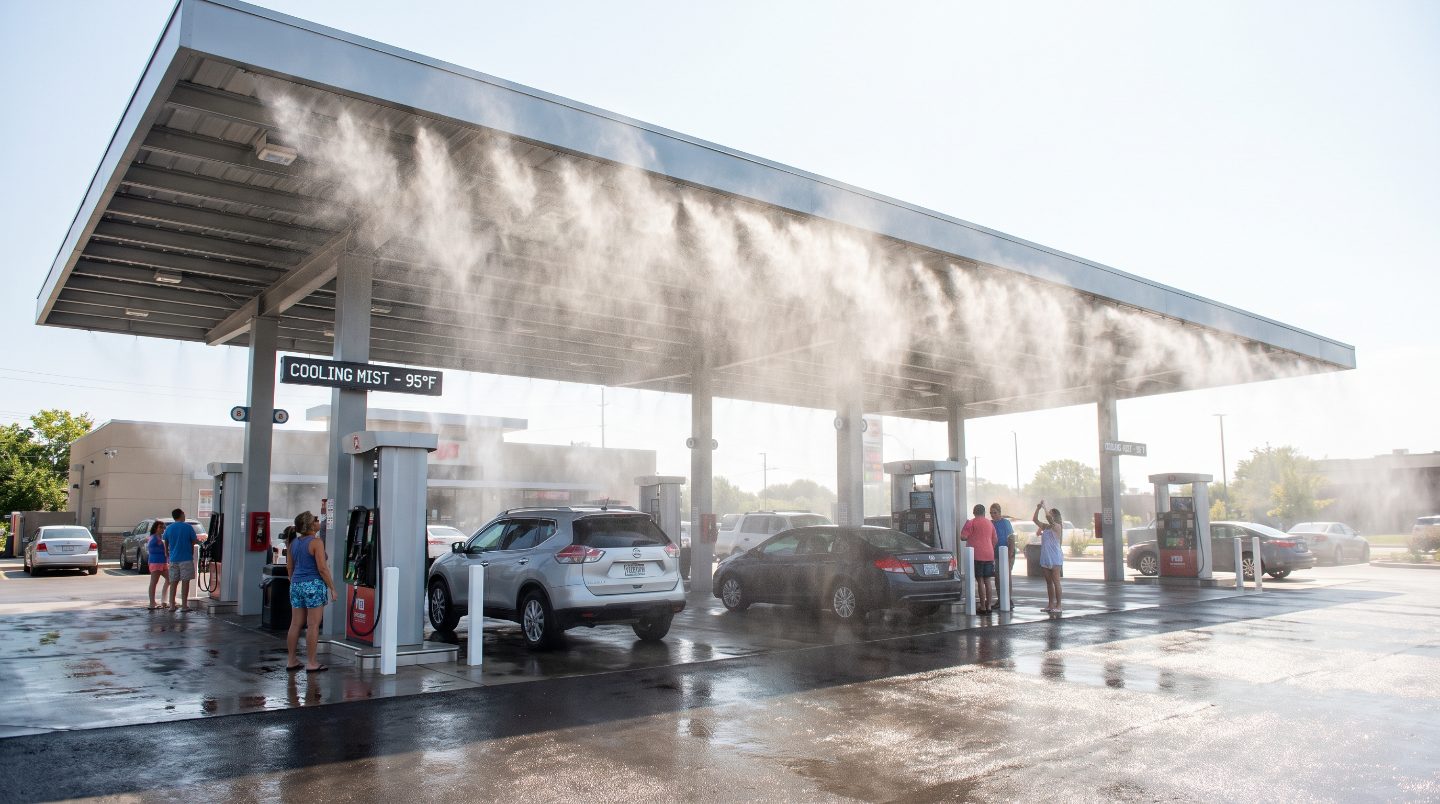
Application of Dehexin High-Pressure Misting Cooling Systems at Gas Stations
Pipeline layouts and main unit specifications—including flow rates and pump assembly power—are customized based on the specific span, canopy height, and wind conditions of the gas station or work site, ensuring comprehensive coverage without any blind spots and without obstructing vehicle traffic.
Installing and utilizing a high-pressure humidification and misting system at gas stations delivers five core values and practical benefits:
**Inherent Safety: Rapidly Eliminating Static Spark Hazards** One of the most dangerous safety risks at gas stations is static electricity generated by friction involving people, clothing, or vehicles in dry conditions. High-pressure fine mist rapidly maintains the relative humidity in the fueling island area within the safe range of 60%–70%. It forms a microscopic conductive layer of water molecules on surfaces, accelerating the dissipation of static charges and fundamentally eliminating the risk of static electricity igniting fuel vapors.
**Physical Cooling: Improving the Working Environment and Customer Experience** In summer, heat accumulates under fueling island canopies and reflects off the ground, often pushing the perceived temperature above 40°C. Micron-sized "dry mist" instantly vaporizes and absorbs heat, rapidly lowering the ambient temperature in the immediate work area by 3–7°C. While providing efficient cooling, the mist vaporizes completely without leaving standing water; this protects employees from heat stress and significantly enhances the refueling experience for motorists.
**Environmental Compliance: Suppressing VOC Volatilization and Odors** High temperatures are a primary cause of rapid gasoline evaporation and the generation of Volatile Organic Compounds (VOCs). Misting-based cooling directly inhibits the rate of fuel vapor emission from storage tank areas and dispensing nozzles. Additionally, ultrafine mist droplets capture suspended fuel vapor molecules and airborne dust, significantly reducing odor concentrations and particulate matter, thereby helping the station meet strict environmental regulations regarding the reduction of ozone precursors.
**Loss Reduction: Lowering Evaporative Fuel Loss** For every degree the temperature drops, the "breathing loss" (evaporation) of light petroleum products decreases accordingly. Cooling key fueling areas effectively reduces routine, invisible evaporative losses, indirectly saving the station money on fuel costs.
**Energy Efficiency and Economy: Low Power Consumption and Automated Operation** Compared to traditional air conditioning or high-power fans, high-pressure misting systems consume very little energy and water—typically requiring only hundreds of watts to a few kilowatts per unit. Equipped with automatic temperature and humidity sensors, the system triggers intermittent operation only when conditions are hot and dry. It requires no manual intervention, resulting in low operating costs and a short payback period.
Need help applying this to your project? Talk to our engineering team.